Showing posts with label migraine. Show all posts

Saturday, December 21, 2024

A Look Back at 2023

It's the end of 2024. As I reflect on this year, I realize that I never posted about 2023. So, here it is. 
Note: I wrote this in December 2023.

I last posted about 2022 (and here's 2021). I may not always share an annual blog post. I don't want to place pressure on myself to write one. I'm allowing space for myself to do so, if it feels right. 

I closed out the year wanting 2023 to be "full of peace, calm, grace, and abundance. I want to flow through the challenges that will inevitably show up. I want to be present in moments of beauty and joy."
Photo by Priscilla Du Preez 🇨🇦 on Unsplash

My previous year's review offered a few questions to ponder. While they're good questions to ask about any chunk of time (a day, week, month, year, and so forth), the new year offers an opportunity to consider them for 2023.

What did you overcome this year?
I faced a lot of fear this year. I was strong and brave in ways that I haven't always noticed. I took chances and opened myself up in new safe spaces. 

This year, I made huge strides in changing the way I relate to myself and my emotions. 
  • I'm learning how to be more aware of and better identify and express my emotions. 
  • I'm learning more about what I need and want. 
  • I'm learning new ways to use my voice. 
  • I'm learning more about neural pathways and the relationship between my thoughts, emotions, and physical sensations. 
What brought you joy this year?
So much has brought me joy this year. I feel like I'm seeing things through clearer eyes, in some ways. Depression has loosened its grip on me, and life is brighter. 

I have a support system that has offered me safe presence, encouragement, feedback, and guidance. I love sharing space with these souls, even if it's mostly virtually. 

I have been able to spend time with people I love, in-person and virtually. I have been writing more, exploring new recipes, and taking more pictures of beauty.

What do you want next year to look like?
I want next year to be a time of growth and rest, consistency and change, depth and frivolity. I want there to be meaningful conversations, moments of joy, soulful connections. I want my days to be filled with creativity, love, and laughter. 

Questions for reflection (and sharing, if you'd like to). Feel free to adjust the timing to what feels right for you. Perhaps you want to consider these questions for a month, quarter, etc. 
  • What did you overcome this year?
  • What brought you joy this year?
  • What do you want next year to look like?
"Write it on your heart that every day is the best day in the year." - Ralph Waldo Emerson

Thursday, January 4, 2024

A Year in Review (2022)

Note: I wrote this in December 2022.

I don't always do a year in review sort of post, though I did in 2021. I was recently part of a writing group that prompted me to consider some questions about this year.
eberhard 🖐 grossgasteiger on Unsplash


This year has been an intense year. There has been a lot of deep sadness and grief. Depression has taken hold multiple times. Anxiety has spun me around more times than I can count. Pain remains my daily companion.

Through it all, God has remained faithful. I'm grateful for His provision, especially when I don't know what I need.

I have overcome a lot this year. I've made it through every single time that I wasn't sure I would. Every time. Every. Time. I will continue to make it through, even when I'm not sure how.

I did a lot of hard work this year. I tackled depression with TMS (transcranial magnetic stimulation), Ketamine, and therapy. I completed a 3-week intensive pain rehabilitation program. I consistently showed up for physical therapy, both in office and at home. I made it through pelvic trigger point injections and acupuncture. A lot of needles. A lot of pain. A lot of work.

I am a warrior. I’m tired of fighting, and I'm doing my best to find balance.

I still have a long way to go to get to where I want to be. Where I thought I would already be. I'm doing my best to accept where I am and continue working to get to where I want to be.

I spent time with family and friends this year, both virtually and in-person. I enjoyed moments of love and laughter.

I want next year to be full of peace, calm, grace, and abundance. I want to flow through the challenges that will inevitably show up. I want to be present in moments of beauty and joy.

Intentionally reflecting allows me to recognize how far I've come.
  • Writing about the obstacles that I overcame reminds me of my strength and resilience, and God's faithful provision.
  • Remembering the people and moments that brought me joy reminds me of all that I'm so very grateful for.
  • Looking forward to the coming year reminds me that there's space to grow and change, and that there's always hope.
Questions for reflection (and sharing, if you'd like to):
  • What did you overcome this year?
  • What brought you joy this year?
  • What do you want next year to look like?
"Year's end is neither an end nor a beginning but a going on, with all the wisdom that experience can instill in us." - Hal Borland

Saturday, October 21, 2023

A Letter to Myself

It's been 15 years since I was in a car accident that altered the trajectory of my life. I've written and posted about it multiple times over the years. Each time differs, as the grieving and healing processes continue. 
Note: links to previous posts about the anniversary of the car accident at the end of this post.

This year feels different. 

The past year has included a Pain Rehabilitation Center (PRC) program, Emotional Awareness and Expression Therapy (EAET) course, and attending a writing support group, all of which have provided me resources and opportunities to make important changes in my life and within myself. I will share more about these in future posts. 

Today, I want to share a letter I wrote to myself. I've written multiple different letters to myself over time. These letters offer compassion, guidance, and encouragement to myself, reminding me that I can and will make it through whatever hard thing I'm facing. They serve as a gentle guide, map, or light for me to get through the difficult times. Here is one such letter. 

My dear self,
I know you’re struggling and your heart feels heavy. Pause and take a breath. 
Feel the air come in through your nose and out through your mouth. Notice how that feels in the body. 
You are going to get through this, just as you have every hard thing before. 
Breathe. 
Rest. 
Identify and acknowledge the emotions and core beliefs that come up. 
Be gentle with yourself. 
Write. Writing helps to gain clarity and release hurt better than anything else. 
Pray. Ask God to come alongside you and provide what you need in each moment. He is faithful. 
Reach out. Jeremy is your strongest supporter in life. Allow him, and others, to be there for you. 
Use the skills and tools you’ve learned and strengthened over the years: breathing, healthy coping and distraction, and resilience. 
You are so resilient! You persevere through challenges. You are a warrior. 
Listen to music. Look for beauty. Bake a cake. Play a game. Write, write, write. 
Do these to help you feel like you again. 
Breathe and let go of what you’re able to. 
I’m so proud of you! I'm proud of you for never giving up, for doing the hard work, for always holding onto hope as well as you were able. 
Keep going, you’ve got this.
Love, Me

Photo by Jamie Valendy
I wrote this letter during the PRC program in 2022. I wrote it on October 10. That day has a history of pain and redemption, over the years.
  • It was the day that I was in a car accident that changed my life. 
  • It was the day that I started seeing my amazing headache specialist.
  • It was the day that I wrote this letter to myself and graduated from a pain rehabilitation program. 
A lot has changed in the past 15 years. I have picked up the pieces of a shattered life, more than once, and chosen what to keep and what to let go of. I have fought battles within (and out) that few or no one knows about. I have worked hard to become the person I am, and I will continue to keep (re)building and growing. 

I've got this!

If you'd like to listen to me read this letter, you can! I was asked to share on a recent US Pain Foundation Building Your Toolbox talk about the importance of writing. Click here to listen on YouTube (https://youtu.be/AolqG1FvoUw). I read at 24:00.

Sunday, October 10, 2021

Reflecting 12 Years Post Accident (2020)

I wrote this post last fall (October 2020), as the anniversary of the car accident approached. 

Over the years, the meaning and emotion of the event have ebbed and flowed in a way that perfectly illustrates the grief process. I've written about this multiple times before: 
When I moved to Arizona in 2017, I started seeing a headache specialist here. It so happened that the date of that initial appointment was the same as the accident. I consciously chose to take back that date; the move and new provider representing a clean slate of sorts. 

This year has been filled with so much loss, on both the individual and collective levels. Perhaps it's in light of this that I find myself more aware, as the anniversary of the accident approaches.

As 12 years post accident approaches, I find myself reflective. 
Photo by Faramarz Hashemi on Unsplash

Following my accident, I fought hard to get back the pre-accident Jamie. I finally reached a level of acceptance in living with this disease, and fought hard for the Jamie I am today. I'm still a work in progress, no doubt. But, in this moment, I recognize that I've come a long way.

I have to be very mindful about how I think about this. It can be all too easy to spin down a path of what ifs. The truth is, the person I was when the accident happened is frozen in time. She very well might've had a different journey, but the person I missed for so long (and sometimes still do) would be whoever she grew to be over the years. And, that, is unknowable. It will forever be an unknown. So, I must remind my mind that the grass may not have been greener. 

I'm grateful to have some people close to me that know me and love me as I am, not who they wish I was. I want to see me through their eyes, to believe in myself the way they believe in me...  with less self-critical judgment. I'm working on it.

Today, I recognize that living with chronic pain is hard, that each year that passes may affect me differently, that grief is a process with ebbs and flows... and... that I can do more than I think I can, that I can engage with myself with compassion and love, that I can give myself space to experience the grief process in all the ways it shows up. 

(As I'm posting this a year after writing it, I'll share about this year's anniversary in a separate post) 

"Loving ourselves through the process of owning our story is the bravest thing we'll ever do." - Brene Brown

Friday, July 17, 2020

In Loving Memory of Jenn Tingwald

My dear friend, Jenn Tingwald, passed away unexpectedly on July 2nd.

I’ve been experiencing the full spectrum of grief. I have tried turning to writing, as it’s always been how I process my emotions and experiences. As I’ve found, though, words are often insufficient to express the fullness of universal human experiences… including, grief. This may be a long, bumpy post; but, I want to share some things I’ve written since I heard the news of Jenn’s passing. 

Words in the Moment 
Today, I found out that Jenn Tingwald passed away last night. I don’t know how those words together can be true. I can’t wrap my mind around it. I know that she was in and out of the hospital a lot over the past few months, but how is she gone? When I read of her passing, my heart broke and my body collapsed. We messaged earlier this week. She wasn’t well, but she was a warrior… like she always was. 

How do I even find the words to describe what I’m feeling? 
I’ve lost people in my life, from drifting away to death. 
This loss is different than others. 
Of course, it hurt badly when my grandparents passed, but they were ill for years beforehand. There was much grieving, sometimes for years, as there were a series of losses before the final one. 
This was different. 
This was completely unexpected. 
Jenn had a lot of health challenges, but she always made it through… until she didn’t. 

I know that grief is a process. I know that the waves will continue to come. Waves of disbelief, sorrow, overwhelm. The waves will vary in size and frequency, but they will continue. 

Today, it’s waves of disbelief and overwhelm. I can’t grasp it, and then it swallows me. It’s such a difficult part of being human. All day, I’ve sobbed and keep saying, “I don’t understand.” 

I know that a lot of things I do will remind me of her, as we shared so many ups and downs together. Living with chronic pain (struggles, successes, treatments, disability, etc), Mayo Clinic, advocacy work (including, Headache on the Hill and Miles for Migraine). Right now, that seems overwhelming. I'm reminding myself that each of these is an opportunity to respond with gratitude for our friendship and move forward with courage and perseverance, knowing she's with me in spirit.

Every ounce of me knows that she’s finally out of pain and with our Lord. I know that I’ll carry her with me, as will the many others whose lives she touched during her time on earth. I’m grateful for all of that, truly. 

Letter to Jenn
My dear friend, 
It’s been a week since you passed. I’m still trying to wrap my mind around you not being here. My heart aches and tears continue to stream down my face as waves of sorrow and overwhelm wash over me. I’ve been thinking a lot about you, and about our interactions. 

I remember the first time I met you. We were at the final American Headache and Migraine Association conference in November 2017. We sat next to each other all morning, but neither of us spoke to one another because we were both managing a migraine attack and medication side effects. As we broke for lunch at the end of the conference, we started talking (my mind doesn’t remember clearly if we just started talking or if Dr. Starling introduced us). Either way, we learned each other’s names and chatted a little. Then, we connected through social media, and grew our friendship. I’m so grateful that we didn’t allow the opportunity to meet pass us by. 

You were the first local friend I made, after Jeremy and I moved to Phoenix. I didn’t know how I’d make local friends, given the limitations of this disease; but God crossed our paths and we became close friends quickly. 

Over the past couple years, we were open books with one another, allowing for a depthful connection that transcended the number of days we knew each other… 956 days. I cherish the conversations we shared about faith, advocacy, and the challenges and successes of living with chronic illness. 

You loved fiercely. I think that’s something we have in common. Your love for your family was unquestionable and second only to your love for God. I always enjoyed hearing stories and seeing pictures of your daughter. She is so precious, and I’m grateful that I was able to meet her in-person this March. 

Among other things, I will never forget your generosity and kindness. You always did your best to support and encourage me, despite the challenges you faced. Thank you for that. 

You made a difference in so many people's lives. Amongst the darkness of losing you, your light continues to shine. It's there in the lives you touched. It's undoubtedly you, and it's beautiful. 

It’s been two weeks since you passed. How can that be? My experience of time is warped. I want to tell you that it was such an honor being friends with you. Thank you for always encouraging me to simply be myself and reminding me to speak from my heart. What a beautiful gift. 
Goodbye, for now, my friend. 

Tributes

I was asked to share an overview of Jenn's headache disorders advocacy:
Jenn Tingwald was a fierce advocate for the headache disorders community. She participated in Headache on the Hill multiple years, spoke at two Phoenix Miles for Migraine events, and was featured in a PBS Newshour special that aired in February. Jenn openly shared about her and her daughter’s experiences living with headache disorders, and highlighted the importance of finding your voice and reclaiming your purpose through advocacy.
Jenn’s husband, Aaron, generously provided an opportunity to share a short video with a story about Jenn. I have many, but the one that was on my heart perfectly displays the kind, generous spirit of my dear friend: 
Jenn and I met at a migraine advocacy event in fall 2017 and quickly became friends and fellow headache disorders advocates. Last year (2019), Jenn and I were going to room together for Headache on the Hill. A couple days before the training, she canceled her trip. She desperately wanted to go, but she needed to focus on her health. When a horrible migraine attack knocked me down after my travel day, she tried to coordinate getting heat pads and Epsom salt delivered to me. Despite the challenges she faced, she messaged me throughout my travels and the Headache on the Hill event. She told me she’d be with me in spirit, and I could feel her presence every step of the way. 
Jenn was one of the strongest, most kind-hearted people I’ve ever known. She was a fierce advocate, especially for her daughter. And, she was a faithful prayer warrior. She always encouraged me to be myself and speak from my heart, especially when she knew I was anxious. I know she’ll continue to be with me in spirit, and I’ll hear her voice reminding me, “You’re going to do amazing!” 
For anyone interested: 
“The reality is that you will grieve forever. You will not ‘get over’ the loss of a loved one; you will learn to live with it. You will heal and you will rebuild yourself around the loss you have suffered. You will be whole again but you will never be the same. Nor should you be the same nor would you want to.” - Elizabeth Kubler-Ross and David Kessler

Sunday, June 21, 2020

Shades for Migraine 2020

Today, June 21, is Migraine Solidarity Day (aka, Shades for Migraine).

Shades for Migraine is a global campaign hosted by the Association of Migraine Disorders to promote migraine awareness and show support for the 1 billion people living with migraine disease worldwide. 

The collaborative campaign is simple to participate in: wear a pair of sunglasses of June 21, post a photo to social media with the hashtag #ShadesForMigraine, and challenge others to take part, too.

"Show you care, wear a pair."

Quick shoutout to my Dad: Happy Father's Day! 

© 2020 Jamie V.
 
© 2020 Jamie V.
© 2020 Jamie V.


Tuesday, June 16, 2020

Headache on the Hill Fundraising Event

Taking part in headache disorders advocacy is an important part of my journey living with chronic pain. While I participate in advocacy work throughout the year, one of my favorite events is Headache on the Hill (HOH) - you can follow the link to read about my HOH 2020 experience.

HOH is an annual event that brings together a large group of advocates in DC to share our stories, and call on lawmakers to recognize the impact and take action to reduce the burden (individual and societal) of headache disorders.

The Alliance for Headache Disorders Advocacy (AHDA) organizes the annual HOH event and covers one night hotel for each attending advocate. Most advocates must cover the remaining travel costs out of their own pockets.

In order to support the HOH event and provide assistance with travel scholarships for advocates to participate, Miles for Migraine is collaboratively* hosting a first-annual walk/run/relax fundraiser event from June 29 to July 7. 

There are a few different ways you can show your support: 
  • Donate (any amount is greatly appreciated)
  • Participate by walking, running, or relaxing (from 6/29 to 7/7)
  • Share this post on social media 
© 2020 Jamie V.
This link takes you to the event page: HOH walk run relax event. From there, you can Pledge a Team (Chronic Migraine Warrior), Donate to a Participant (Jamie Valendy), or Register (and join my team). 

This link takes you to my team page: Team Chronic Migraine Warrior. From there, you can Make a donation or Join my team.

Please join me!

"Each one of us can make a difference. Together we make a change." - Barbara Mikulski

*Participating non-profit organizations for this event include:

Tuesday, June 9, 2020

Migraine World Summit 2020 Replay

The Migraine World Summit is a virtual event that broadcasts interviews from over 30 leading experts, including doctors and specialists, to share about treatments, research, and strategies to help you manage and improve your headache disorder. 

The 2020 event took place in March. Due to the significant challenges we’re facing in the midst of the Covid-19 pandemic, the event is being offered again from June 10-19. 
The event is FREE: the interviews will be open according to the event schedule (4 per day, plus 1 webinar), changing each day at 6pm ET. You can access the interviews directly on the website free for 24 hours. If you’d like to have lifetime access to the interviews, you can purchase the Summit All-Access Pass (affiliate link).


Tune in June 9 at 5pm ET for a Live Pre-Summit Q&A with Hosts, Carl Cincinnato and Paula Dumas. They’ll explain why the Summit is being replayed, what’s new about the June Replay, and answer other questions. It’s free to join, but you must register beforehand. Click the link to register (no sign up required) for the Live Pre-Summit Q&A.

Monday, June 1, 2020

Wear Purple & Headache at Work

June 1 is the first day of Migraine and Headache Awareness Month (MHAM). Today, we’re highlighting a headache awareness initiative and headache at work. 

© 2020 Jamie V.
Wear Purple to Work (at Home)

The National Headache Foundation (NHF) created an initiative to help promote migraine and headache awareness: Wear Purple to Work (at Home). On June 1, wear purple and share a photo on social media to show solidarity for the 40+ million people in America living with headache disorders. 

When you share on social media, please use the hashtags: #MHAM #MHAM2020.

Headache at Work

Work often includes facing a slew of headache and migraine triggers that can stack and result in increased attacks: bright lights, computer screens, strong odors / scents, loud noises, stress, rigid schedules and deadlines, the list goes on. 

Many people are working from home during the pandemic. For some, work being moved to a virtual / from home format is proving to allow the flexibility needed to be a more productive worker and have improved quality of life.

It’s unclear what the work landscape will look like, as more workplaces decide how to move forward. It remains important to recognize the need for employer accommodations for those living with headache disorders. Hopefully these months of virtual workplaces will provide the evidence needed for companies to consider offering employees more options moving forward. 

Once workplaces bring people back to the office, the Migraine at Work campaign provides tools and resources for employers and employees to utilize. 

"I don't have a dis-ability, I have a different-ability." - Robert M. Hensel

Sunday, May 31, 2020

Migraine and Headache Awareness Month (MHAM) 2020

June is Migraine and Headache Awareness (MHAM) Month. This year’s theme is: You need community. #MHAM #MHAM2020 #YouNeedCommunity

If you're interested in learning more or getting involved, Migraine Headache Awareness Month is a great resource for information regarding upcoming activities being hosted by various individuals and organizations within the headache disorders community.

I’ve participated in Migraine and Headache Awareness Month, since it started in 2012. Some years, I’ve been able to participate more than others. One thing that hasn’t changed, is the excitement of coming together with others in the community to share our stories and do what we can to raise awareness, decrease stigma, and make the invisible visible. 

In the past, there have been daily blog and social media challenges. I’ve enjoyed participating in those ways, but I’ve also struggled with feeling guilt and shame for not being able to keep up. That’s something I continue to work on, as the pressure to perform is self-inflicted. 

I’m not sure how this year’s awareness month will look, from my participation standpoint. Perhaps I’ll take the opportunity to share some photos and stories from previous advocacy activities and even some attacks (I’ll be sure to label with the date, so it’s clear when they were). Whatever it looks like, I’ll write and share… and, I’ll be proud to be part of a community of people that “get it.” 

Here’s how to find me and follow along: Blog – subscribe by email.  Facebook.  Instagram.

“One of the most important things you can do on this earth is to let people know they are not alone.”
 - Shannon L. Alder 

Thursday, March 5, 2020

An Update & More Migrainous Musings

I have been struggling with a rough stretch of status migrainosus. I sometimes get flashes of clarity or expression, when I'm in the midst of deep distress... sometimes I'm able to capture the words, scribbling them down wherever I can. Last year, I shared some Migrainous Musings. I'm here, again, yet there's little comfort in the familiarity of this place. The timelessness and dominance of pain described in Pain has an Element of Blank continues to resonate and ring true to my own experience.

I continue to share, and hope you'll excuse the raw, unedited migrainous musings / ramblings of a brain in pain.

There's an emptiness inside me that knows no bounds.
Sometimes it tries to swallow me up.
Is it the pain? The anxiety? The depression?
Or is this emptiness me?

To know me truly,
See the darkness inside me,
Then don't turn and run.

The darkness surrounds.
Is it here to stay this time?
Please don't consume me.

I do not fear the darkness in others. I generally don't fear it in myself. But, there are times that it becomes overwhelming, and I can't see the light.

I feel like I'm disappearing. Shattering into tiny pieces and blowing away in the wind. Like I'm a fragile shell, being crushed by the weight of darkness. Do I still exist? What is left of me, when the pain overflows?

I'm not ok. I know I've been in this place before, and somehow come out the other side. But, that doesn't compute right now. This feels like my forever. Like I'm trapped.

Update 1 (March 3):

I've spent most of the last week in the hospital getting infusions to try to break this status migraine.


Six days. Three IVs. Loads of meds. My mind and body are still in turmoil, and I don't know how long it'll take to feel like me again. I've been here before. I know that I get out. But, I don't know how. It feels too hard. I feel too weak.

Update 2 (March 4):

Today is filled with more pain than I feel I can bear. I'm not sure how I can survive it. I've treated hard. I'm trying to give myself rest. Nothing feels enough. I know I'll get through it... somehow... because I always do. Every time. Yet, even that gives me no solace in this moment.

Update 3 (March 5):

I woke today feeling more me than I have in a long time. Pain levels are lower. My mind and body are so weary and I can feel the weight of the battles fought. But right now, in this moment, I'm praising God for His provision and the respite.

"At the end of the day, we can endure much more than we think we can." - Frida Kahlo

Monday, February 17, 2020

Headache on the Hill: Behind the Scenes

As I began writing about my Headache on the Hill 2020 experience, I found a post that was written but never posted from last year's event. The following post is from 2019, though much of it is timeless.

Photo by Ian Schneider on Unsplash
In writing about my experience and the asks of Headache on the Hill (HOH) 2019, I realized that there's another side that needs to be shared.

Every person that went through the process to participate in HOH has their own story of the event. Some people weren't able to make the trip because of health, financial, or other reasons. Some pushed to make the trip, but were then unable to attend training and/or their meetings on the Hill because of health. Some pushed to participate, and then crashed hard afterward.

Headache diseases can be unpredictable. And, everything that participating in a lobbying event like HOH entails adds up and can be difficult to do while living with the uncertainty of chronic health conditions.

Sometimes you can push through, and sometimes you can't. There is no shame in that. Oh! But, I know that those unable to attend their meetings were overwhelmed by enormous emotions.

Traveling alone

I haven't traveled much alone, since I became chronic after my car accident in 2008. My husband and I have traveled, but my only solo travel has been to visit and stay with family. Attending HOH was the first non-family related travel that I ventured out on my own. I was both excited for the independence and anxious about managing on my own. Knowing that I had friends also attending HOH helped put my mind at ease.

The day before the HOH training was a travel day for me. I flew across the country alone. Time in a plane is hard on the body, and I was hurting badly, when I arrived in Washington, D.C. I made it to the hotel, checked in, and collapsed onto my bed. A friend of mine invited me to dinner and encouraged me to come, despite my exhaustion and pain. I appreciated being around people that get it, and I know that my body needed an actual meal after a day of snacking. I made it back to my room after dinner, but I was completely spent. The weather outside was worsening, and my head and body pain mirrored that.

Reaching out for support

I reached out to my sister, in tears. The exchange of messages revealed the spiral that pain often takes me on.
"When I hurt, my brain catastrophizes. I'm trying to not be overcome with thoughts about not being prepared tomorrow, should I take meds today, if I take today I can't take more tomorrow, etc... It's just a spiral I go through. It's hard."
My sister doesn't experience migraine herself. She has a truly beautiful heart, though, and has taken note of things that I've mentioned help me in the past. She recommended heat... all I had were hand warmers, but she encouraged me to use them to try to help manage the pain (specifically my neck pain).

One thing that I appreciated was that she made a couple simple recommendations (heat and ice), which can sometimes slip my mind. She acknowledged what she wasn't equipped to guide me on. Through it all, she offered me what I needed most... herself. Knowledge that I wasn't alone. Prayers being sent up on my behalf. Reminders that my my painful groans are wordless prayers that reach our Father, when we cannot find the words. Sharing a beautiful song to speak truth to my heart in a way that it could hear it. The song she sent on that night: Fear is a Liar by Zach Williams.

The person that was supposed to be my roommate wasn't able to make it because of a status migraine, but she did her best to try to help from afar... even going so far as to try to get some supplies delivered to me to help me through the attack.

I ended up treating the migraine attack, and made it through the night. My mind and body felt the effects of the battle that had raged on the previous day, but I was able to attend the training day. After training, I gave my body rest and quiet.

The day we went to the Hill for our meetings, one of the people in my group was having a bad migraine attack. I offered support in the ways that I was able to, and checked up on him throughout the day. We shared that he was missing the day's meetings due to a migraine attack, which highlighted the impact of this disease.

I've observed, heard others' stories, and experienced first-hand, the love and support that this community has among its members. There is an often unspoken understanding that we all experience pain and other symptoms, allowing for deeper connections and support in ways that can feel like home. There is such great power and hope in knowing that we're not alone.

“Give your weakness to one who helps.” - Rumi

Saturday, February 15, 2020

Headache on the Hill 2020

This week, I joined a group of 174 advocates from 45 states in Washington, DC at the 13th annual Headache on the Hill lobbying initiative, which is organized by the Alliance for Headache Disorders Advocacy (AHDA).

2020 Headache on the Hill
This was my second time participating in Headache on the Hill (Headache on the Hill 2019: My Experience). We spent Monday in training and preparing for our Hill visits. On Tuesday, we loaded onto buses to head to the Capitol for a group photo, before splitting up to head to our congressional meetings.

Team Arizona
Team Arizona

The group for Arizona was made up of six amazing advocates: Kerrie Smyres, Dr. Amaal Starling, Amy Tees, Jenn Tingwald, Jamie Valendy, and Don Vanderpool.

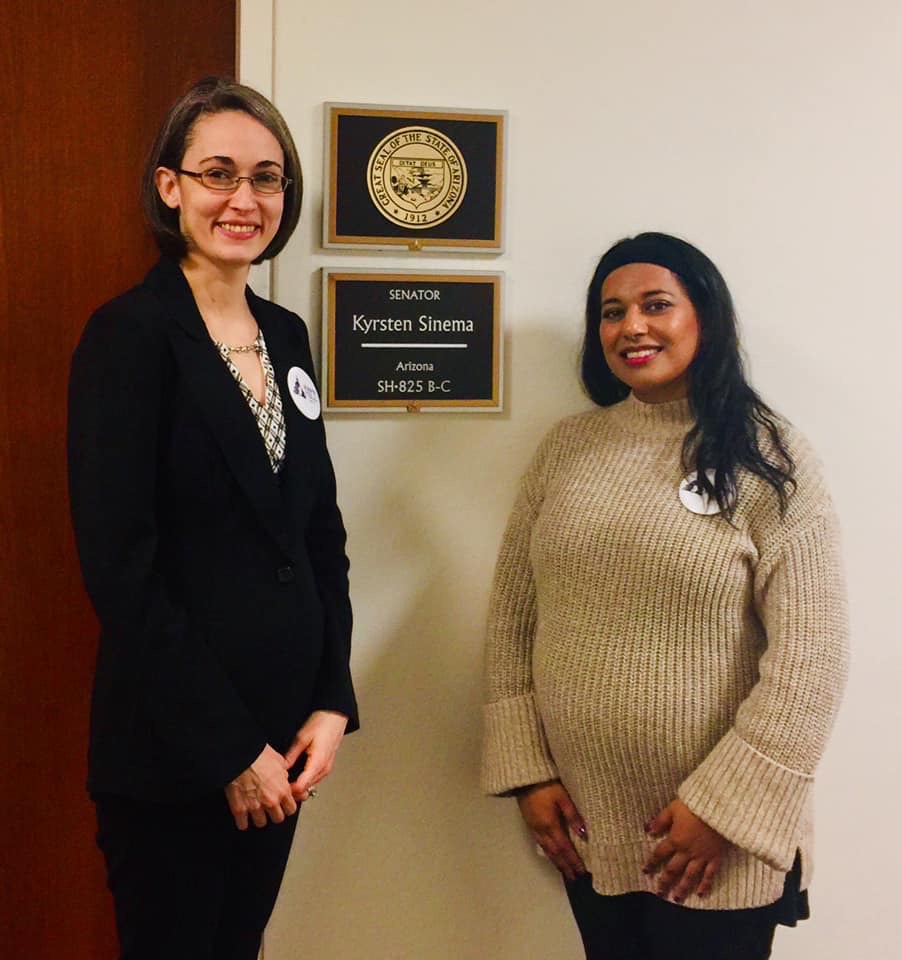
We had a full schedule, meeting with the offices of: Senator Kyrsten Sinema, Senator Martha McSally, Representative Greg Stanton, Representative Ruben Gallego, Representative Paul Gosar, Representative David Schweikert, Representative Ann Kirkpatrick.

Our meetings went well, and we were able to make some connections with the staffers we met with. I never cease to be amazed at the prevalence of headache disorders. Everyone has some connection to them. It reminds me that my voice and story speak for so many others that live with migraine or other headache disorders... and that gives me a push to continue advocating.

Migraine Impact

The impact that migraine has on individuals, families, and society is profound. Sharing my story with legislators gives a face to the disease, while sharing statistics speaks to the pervasiveness and burden of migraine and other headache disorders. 

Migraine is a prevalent and serious public health issue:
  • Migraine is the 2nd leading cause of disability in the United States (1).
  • 47 million Americans will have migraine attacks this year (1).
  • 5 million Americans with migraine will have 10 or more days with headache per month (2).
Migraine is part of the Chronic Pain Crisis in the United States:
  • There are more than 1.2 million emergency department visits for migraine annually in the United States (3).
  • 59% of emergency department visits in the United States for migraine include opioid treatments (2).
  • Opioids are not indicated for the treatment of migraine (4), and opioid use may increase the frequency and severity of migraine attacks (5).
Migraine disease management requires patient access to headache medicine physicians:
  • At least 8 headache medicine physicians are needed per 100k people with migraine (6).
  • There are currently only 1.2 certified headache medicine physicians per 100k people with migraine in the United States (7).
There are only 574 headache specialists in the United States (6). Given the prevalence and burden of all headache disorders, the disparity of current and needed headache specialists is devastating.

The 'Asks'

The United States is facing a huge shortage of doctors, including specialists (8). The Opioid Workforce Act H.R.3414 / S.2892) would fund 1,000 new physician training positions in addiction medicine, addiction psychiatry, and pain medicine.

However, there is a problem with the bill language. It explicitly supports "approved residency training programs in... pain medicine." However, residency training programs do not exist in pain medicine. There are only approved fellowships in pain medicine. There is also no specific mention of headache medicine, which also has only fellowships.

The asks:

  • Urge amendment to H.R.3414 / S.2892 to ensure support of US physician training in:
    • ACGME-accredited pain medicine fellowships
    • UCNS-accredited headache medicine fellowships
  • Co-sponsor the bill and support pain medicine and headache medicine fellowships.

Advocacy Work

Taking part in advocacy work is an important part of my journey living with chronic pain. Being surrounded by others that are passionate about coming together as a unified voice for all people living with headache disorders fills me with hope. There is power in sharing our stories and making connections with others. I'm honored to have been able to participate in Headache on the Hill, again; and I look forward to continuing to do so. 

"Unity is strength... when there is teamwork and collaboration, wonderful things can be achieved." 
- Mattie Stepanek

Sources:
(1) GBD 2016 Headache Collaborators (2018). Global, regional, and national burden of migraine and tension-type headache, 1990-2016: a systematic analysis for the Global Burden of Disease Study 2016. The Lancet. Neurology, 17(11), 954–976. https://doi.org/10.1016/S1474-4422(18)30322-3. https://www.ncbi.nlm.nih.gov/pmc/articles/PMC6191530/.
(2) Blumenfeld, A., Varon, S., Wilcox, T., Buse, D., Kawata, A., Manack, A., Goadsby, P., Lipton, R. (2011). Disability, HRQoL and resource use among chronic and episodic migraineurs: Results from the International Burden of Migraine Study (IBMS). Cephalalgia, 31(3), 301–315. https://doi.org/10.1177/0333102410381145. https://www.ncbi.nlm.nih.gov/pubmed/20813784.
(3)   Friedman, B. W., West, J., Vinson, D. R., Minen, M. T., Restivo, A., & Gallagher, E. J. (2015). Current management of migraine in US emergency departments: An analysis of the National Hospital Ambulatory Medical Care Survey. Cephalalgia, 35(4), 301–309. https://doi.org/10.1177/0333102414539055. https://www.ncbi.nlm.nih.gov/pubmed/24948146. 
(4) Loder, E., Weizenbaum, E., Frishberg, B., Silberstein, S. and (2013), Choosing Wisely in Headache Medicine: The American Headache Society's List of Five Things Physicians and Patients Should Question. Headache: The Journal of Head and Face Pain, 53: 1651-1659. https://doi.org/10.1111/head.12233. https://www.ncbi.nlm.nih.gov/pubmed/24266337.
(5) Thorlund, K., Sun-Edelstein, C., Druyts, E., Kanters, S., Ebrahim, S., Bhambri, R., Ramos, E., Mills, E. J., Lanteri-Minet, M., & Tepper, S. (2016). Risk of medication overuse headache across classes of treatments for acute migraine. The journal of headache and pain, 17(1), 107. https://doi.org/10.1186/s10194-016-0696-8. https://www.ncbi.nlm.nih.gov/pubmed/27882516.
(6) Begasse de Dhaem, O., Burch, R., Rosen, N., Shubin Stein, K., Loder, E. and Shapiro, R.E. (2020), Workforce Gap Analysis in the Field of Headache Medicine in the United States. Headache: The Journal of Head and Face Pain, 60: 478-481. https://doi.org/10.1111/head.13752. https://www.ncbi.nlm.nih.gov/pubmed/31985046. 
(8) The Complexities of Physician Supply and Demand: Projections from 2017-2032, AAMC, April 2019. https://www.aamc.org/news-insights/press-releases/new-findings-confirm-predictions-physician-shortage.

Saturday, September 14, 2019

Headache on the Hill 2019: The Asks

In my previous post, Headache on the Hill 2019: My Experience, I shared about my personal experience at the annual advocacy event. Below is what I wrote at the end of my time in DC. The majority of this post, however, will speak to our 'asks' for 2019.
"The last few days have been an amazing, exhausting, powerful experience. I joined a wonderful group of patients, advocates, headache specialists, and other supporters in Washington, DC for the 12th annual Headache on the Hill. We met with lawmakers to raise awareness, request increased research funding commensurate to the burden of headache disorders, and demand equal protection and just coverage under Social Security Disability Insurance. I was honored to participate - it was especially rewarding to be working alongside my headache specialist. I will continue advocating for all those affected by headache disorders, and look forward to future visits to the Hill."
This year, we asked our members of Congress to support increased research funding for headache disorders from the National Institutes of Health (NIH), and to support requests directing the Social Security Administration (SSA) to revise disease listings for determination of disability benefits for those disabled by migraine and other headache disorders.

Our 'ask' for the National Institutes of Health (NIH) was to prioritize research funding commensurate to the burden of headache disorders. Congress has already appropriated funds for the HEAL (Helping to End Addiction Long-term) Initiative to address the need for non-opioid therapies for chronic pain. Some of those funds have been set aside for research in specific areas (back pain and hemodialysis pain). Our request was that some of the appropriated funds be allocated specifically for headache disorders, in proportion to the disease burden.
  • Migraine is the 2nd leading cause of all global disability (1).
  • Headache disorders are the least funded NIH research area among the most burdensome US diseases (2).
  • Migraine research comprises just 0.6% of all NINDS extramural funding (3).

Our 'ask' for the Security Administration (SSA) was to seek equal protection and just coverage under Social Security Disability Insurance (SSDI). When a person applies for SSDI benefits, they are faced with an unfairly arduous process. When that person is filing a claim for benefits due to a headache disorder, they are often initially denied. What I didn't know until Headache on the Hill is why...

The SSA uses a "Blue Book" listing of impairments, when making decisions for disability benefits. If one's impairments meet or exceed the listing, benefits are granted. However, there are NO listings for any headache disorder!

When a person applies for disability due to a headache disorder, the claim is compared to impairment listings for epilepsy. There is no guidance on how to apply an epilepsy listing to headache disorder impairments, and the two aren't sufficiently comparable.

This is unacceptable, given the prevalence and impact of headache disorders:
  • 1 in 7 Americans will experience a migraine attack this year (4).
  • Active migraine attacks disable with impacts comparable to severe dementia or amputation of both legs (5).
  • Only 37% of Americans with chronic migraine are employed full time (6).
  • Socioeconomic status decreases as migraine prevalence increases (7).
Our 'ask' was to reform the Social Security Administration (SSA) Blue Book for fair adjudication of headache disorder claims. We requested that the SSA offer clarification for how SSDI claimants with headache disorders should apply current Blue Book listings, ensure that all listings are updated at least every five years (it was last updated in 2016, but before that was 1985), and add a listing for headache disorders at the earliest opportunity.

UPDATE: On August 26th, the SSA released a new Ruling or SSR with guidance specific for "Evaluating Cases Involving Primary Headache Disorders."

More information about Headache on the Hill 2019:


Sources:
(1) GBD 2016. Global, regional, and national incidence, prevalence, and years lived with disability for 328 diseases and injuries for 195 countries, 1990-2016: a systemic analysis for the Global Burden of Disease Study 2016. Lancet 2019;390:1211-59, https://www.thelancet.com/journals/lancet/article/PIIS0140-6736(17)32154-2/fulltext
(2) https://report.nih.gov/info_disease_burden.aspx 
(3) https://report.nih.gov/categorical_spending.aspx
(4) Global Burden of Disease study, 2016, https://www.ncbi.nlm.nih.gov/pubmed/28919117.
(5) Salomon JA, et al. Disability weights for the Global Burden of Disease 2013 study. Lancet Glob Health 2015;3:e712-23, https://www.thelancet.com/journals/langlo/article/PIIS2214-109X(15)00069-8/fulltext.
(6) Stewart WF, et al. Employment and work impact of chronic migraine and episodic migraine. JOEM. 2010;52:8-14, https://www.ncbi.nlm.nih.gov/pubmed/20042889. 
(7) Stewart WF, et al. Migraine prevalence, socioeconomic status, and social causation. Neurology. 2013;81:948-55, https://www.ncbi.nlm.nih.gov/pubmed/23990405.

Friday, September 13, 2019

Headache on the Hill 2019: My Experience

In February, I joined a group of 160 advocates in Washington, DC at the 12th annual Headache on the Hill lobbying initiative. The event is organized by the Alliance for Headache Disorders Advocacy (AHDA). Healthcare professionals, advocates, and patients come together to request that lawmakers recognize the impact of headache disorders and take action to increase research funding and awareness.

This was my first time participating in Headache on the Hill. The first day was filled with advocacy issue training and Hill visit preparation. We learned more about what our 'asks' would be (I'll share more in a separate post, Headache on the Hill 2019: The Asks, if you're interested) and we practiced sharing our personal stories of living with headache disorders, so that we'd be prepared to approach and interact with our policymakers.

The following day, we all came together for a group photo and a policy meeting, and then we broke up into small groups to visit our respective congressional members' offices.

My group didn't have scheduled meetings until the afternoon, so we split up to rest until then. One of our group members was unable to attend meetings because he was dealing with a migraine attack. While I know that being unable to participate was in many ways just as excruciating, we carried his story with us and used it in our meetings as a powerful example of what living with migraine disease is really like.

One group member down, I spent the day partnered up with my headache specialist (Dr. Amaal Starling) to attend our scheduled meetings.
  • Our first meeting was with a staff member, and we felt a lack of interest in what we were sharing.  
  • Our second meeting ended up being part of a "roundtable" situation, which basically meant that there were multiple groups there during the same time-slot, but the Representative was there in person. He had some personal interest in headache / migraine, but was dismissive to me as someone living with migraine and focused his attention on my partner (as a healthcare provider). 
  • Our third meeting revealed the misunderstanding and stigma of headache disorders, but was where we really leaned on the story of our missing group member, as it was his congressional district's office we were visiting.
Based on conversations with others that have attended Headache on the Hill before, my experience during the three meetings I attended were a bit different or rougher than "normal." It may have been a push into the deep end, but Dr. Starling and I worked well together in advocating for the headache community.

It was quite powerful to be surrounded by so many people with a passion for advocacy work. We were all on a single mission: to be the voice of all people living with headache disorders. We bravely shared our stories, to help others better understand what it's like to live with these diseases. I'm honored to have been able to participate, and I look forward to continuing to do so.

"There is no power for change greater than a community discovering what it cares about." 
- Margaret J. Wheatley

Friday, February 8, 2019

Upcoming Happenings

I wrote in Farewell, 2018! about having a word or phrase to guide and grow in during different times.
Along those lines, there are some exciting events coming up over the next few months. Here's a sneak peek, but I'll definitely share more.

Headache on the Hill (February 12)
Photo by Nerdy Rockson on Unsplash
Headache on the Hill is an annual lobbying event in Washington, DC, where healthcare professionals, advocates, and patients come together to request that lawmakers recognize the impact of headache disorders and take action to increase research funding and awareness.

Miles for Migraine Walk / Run (March 2)
Miles for Migraine is focused on improving the lives of those living with headache disorders, by increasing public awareness, fighting stigma, and raising funds for migraine research. 

Migraine World Summit (March 20-28)
Migraine World Summit is a virtual event that will provide talks from "over 30 of the world’s top migraine and headache experts, doctors, specialists, researchers, scientists, geneticists, psychologists, authors, and advocates." The event is FREE (4-5 talks will be released per day, and will be available for free for 24 hours). If you can't listen during those dates, the Summit will be available for purchase. Click here, to claim your ticket for the 2019 Migraine World Summit.

RetreatMigraine (April 12-14)
RetreatMigraine is a conference focused on people living with migraine disease. It will provide "support, community, disease and treatment education, advocacy training, and complementary therapy experiences."

Headache on the Hill
Miles for Migraine
Migraine World Summit
RetreatMigraine
   

Tuesday, January 29, 2019

Checking In

I disappeared for a while, and I apologize. When I wrote Migrainous Musings, I was two weeks into an intense status migraine. Unfortunately, it persisted.

Following an unsuccessful round of corticosteroids, I completed a 3-day course of outpatient infusions. They brought it to a bit more manageable level, but it didn't help as much as they did last summer when I did them.

Photo by Kelly Sikkema on Unsplash
Then, I got sick. Deciphering whether head and face pain is from migraine or sinus pressure / mucus is tricky... much less how to treat it. A couple days in, the coughing started and made my asthma flare. Dealing with common sickness on top of chronic illness is unpleasant.

I've been doing my best to allow my mind and body the time and space to rest and heal, but it's hard.

Fatigue, depression, anxiety, insomnia from meds, boredom / difficulty distracting oneself... all on top of the ongoing pain and other symptoms.

I'm trying to complete what I can, when I can, how I can. Then, do my best to practice grace and compassion with myself.

"Give yourself the same compassion and grace that you give to the people in your life that you love the most." - Jennifer Rothschild

Disclaimer: Nothing on this blog is intended as medical or legal advice.

What I write on this site is my own, and if it is someone else's, I take special care to attribute it to the original author. So, please don't use any of my material without proper attribution or permission. Thanks.